Shop operations
Billing during the Dashain rush: a fast counter without mistakes
Where a crowded festival counter loses time and money, and the barcode, invoice, payment, discount and day-end habits to fix before Ghatasthapana.
By Sulachhan Shiwakoti · Chief Executive Officer, Kuver Books · Published · 12 min read
- Dashain
- Tihar
- POS billing
- Barcode billing
- Day-end cash close
In short
Fast billing during the Dashain rush comes from preparation, not from faster hands. Put a scannable barcode on every item before Ghatasthapana, ask whether the customer needs a VAT bill before you start, record wallet and QR payments as their own method, limit discounts to named roles, and count the drawer against recorded takings every night.
On this page
- Where does a festival counter actually lose time?
- Barcode every SKU before Ghatasthapana
- Abbreviated tax invoice or full tax invoice: which does a walk-in customer get?
- Record wallet and QR payments as what they are
- How do you close the cash drawer at night during Dashain?
- A second billing point, and who may give discounts
- Printer paper, power cuts and a dropped connection
- Returns and exchanges after Tihar: credit notes, not deleted bills
- Pre-festival counter checklist
- When a notebook and a calculator are enough
- Before you switch systems this festival season
Billing during the Dashain rush goes wrong in the same four places every year: long queues, wrong prices, bills that were never issued, and a cash drawer that does not match at night. A faster cashier does not fix any of them. You fix them in the four weeks before Ghatasthapana: label the stock, decide who may give discounts, and agree how every payment is recorded.
This post is for the shops that feel the rush most: clothing stores, kirana shops and supermarkets, mobile and electronics shops, sweet and gift shops, and pharmacies. Dates below are as published in the 2083 calendar: Ghatasthapana on Sunday 11 October 2026, Vijaya Dashami on Wednesday 21 October, and Tihar from 7 to 11 November, with Laxmi Puja on 9 November and Bhai Tika on 11 November.
Stock planning comes first; our Dashain and Tihar stock planning guide covers it. This post starts once the goods are on the shelf.
Where does a festival counter actually lose time?
The printer is rarely what slows the queue. These things usually do.
Price lookups. A cashier who has to shout to the floor or check a rate list loses more time on one item than on scanning ten.
Typing items. Every typed item is a chance to pick the wrong size, pack or rate.
Change. A drawer out of small notes at 4pm stops the queue.
Wallet confirmations. A customer’s payment screenshot proves nothing; the confirmation that counts is on the shop’s own merchant app or account.
The VAT question asked too late. A buyer who needs a claimable bill, and says so at the end, turns a finished sale into a correction.
Reprints. Each reprint costs time, because under the Electronic Billing Procedure 2074 a second copy must be marked as a copy and counted.
Barcode every SKU before Ghatasthapana
Barcode billing replaces typing with scanning. Speed is the smaller gain. The scan also carries the rate and tax, so the bill shows the price in the system instead of the price the cashier remembers.
The work is in the weeks before:
- Items with a supplier barcode only need that barcode mapped to your product once. Kirana and pharmacy stock is mostly like this.
- Items without one, such as garments from a local maker or gift hampers you pack yourself, need your own label printed and stuck on before they go to the shelf.
- Each size and colour is its own item. A label on the design alone puts you back to guessing. Our clothing store POS page covers variants in more detail.
- Loose sweets sold by weight are often quicker with a short searchable product code.
In Kuver Books, you map barcodes to products in Barcode Management. From there you can download each barcode’s label for printing, and give a barcode to a product that has none. At the counter, input made only of digits is read as a barcode: Enter adds the item, and scanning it again raises the quantity. One barcode belongs to one product only, and a duplicate is rejected when you save. That is exactly the check you want before a rush.
Abbreviated tax invoice or full tax invoice: which does a walk-in customer get?
Most festival customers are shoppers who will never claim input VAT. For them, a registered seller may issue an abbreviated tax invoice. It is a shorter bill with your details and registration number, a serial number, the date, what was sold and the amount including tax.
A registered business buying gifts or stock for its own staff is different. If they want to claim the tax, they need a full tax invoice carrying their name, address and registration number, with VAT shown separately.
Three rules keep this clean at a crowded counter:
- Ask before the first scan. “Do you need a VAT bill?” takes two seconds. Switching document type after the bill is issued is the part the rules make hardest.
- Keep one sequence. Both documents are numbered records in the same sequence discipline. An abbreviated bill is not a licence for loose slips.
- Mind the value limit. Above certain values, and for certain supplies, the full document is required. The VAT invoice requirements guide sets out both formats, but it does not publish a figure and nor do we, so confirm the current limit with the IRD or your accountant before Ghatasthapana.
Save registered buyers who come back often as customers. Their registration number and address then fill in by themselves, and nobody types them while the queue waits.
Record wallet and QR payments as what they are

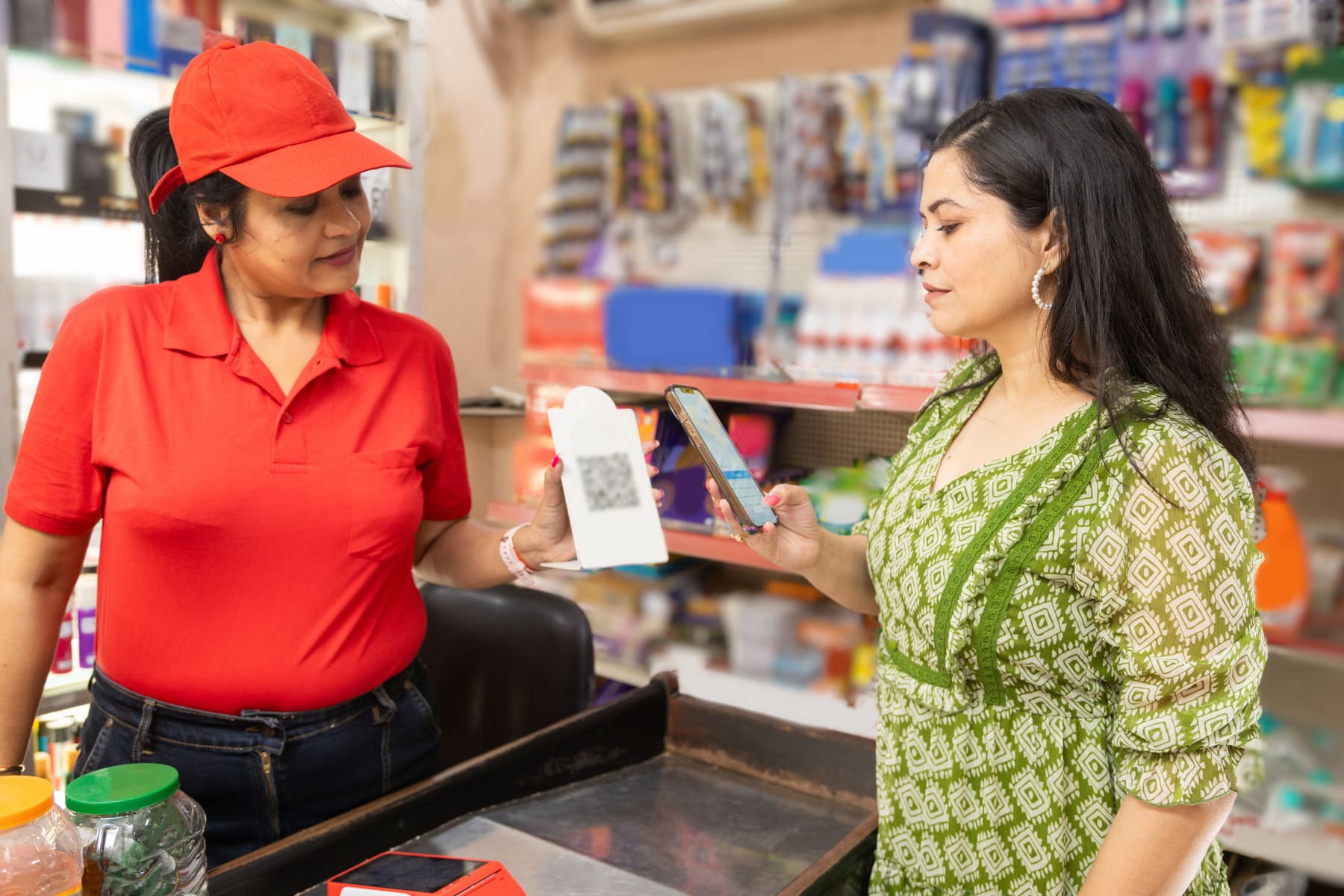
Much of a festival counter’s takings may never touch the drawer. That is fine, as long as each payment is recorded against the method it arrived by.
Record payments across 10 Nepali methods: cash, Khalti, eSewa, bank transfer, ConnectIPS, Fonepay, IME Pay, PrabhuPay, card and mobile banking. Each payment carries its method and the bank account it landed in. Kuver Books records how the customer paid. It does not process the payment: the money still moves through your own wallet, bank or QR account.
Here is why it matters at night, with an illustrative example. A cashier sells a kurta for Rs 3,200, the customer pays by Fonepay, and the cashier records it as cash out of habit. The drawer now looks Rs 3,200 short, and someone spends closing time hunting for money that is sitting in the bank.
Two habits prevent it:
- Confirm on your side before handing over goods. Check the shop’s own merchant app or account notification, not the customer’s screen.
- Pick the method on every payment. No defaulting to cash. When a customer pays part in cash and part by wallet, record two payments against the same invoice.
How do you close the cash drawer at night during Dashain?

A day-end close compares what is in the drawer with what the day recorded, then writes the result down so tomorrow starts from a known figure.
An illustrative example for one counter on a busy Saturday:
| Line | Amount (example) |
|---|---|
| Opening float, counted at 9am | Rs 5,000 |
| Cash sales recorded | Rs 1,42,300 |
| Cash refund handed over on a return | minus Rs 2,000 |
| Expected cash in the drawer | Rs 1,45,300 |
| Cash counted by denomination | Rs 1,44,800 |
| Difference | Rs 500 short |
A small shortfall is usually change given wrongly. A shortfall the size of a sale is usually a wallet payment recorded as cash, and one the size of a return is usually an unrecorded refund. Write the difference down with the date, shift and reason. A pattern across the week only shows if you recorded the first one.
In Kuver Books, the day-end splits takings by payment method. The cash ledger records every movement in date order, with opening and closing rows. Once a day has been printed it locks, so yesterday’s figures cannot change. To move the float to the bank you fill in a form that shows available, transferring and closing balances as you type. A cash adjustment needs a reason and a supporting document before it posts.
A second billing point, and who may give discounts
One counter cannot handle the Saturday before Dashain or the evening before Laxmi Puja. A second billing point with its own scanner and printer helps more than any shortcut. It is only safe if the system gives out the invoice numbers, instead of each cashier. In Kuver Books, the system numbers invoices in sequence for each fiscal year. Each user is created with a role and assigned to a branch, so every bill carries the name of the person who raised it.
Discounts are where a festival counter leaks margin. “Dashain offer, dai” becomes a habit by the third day. Role-based access control turns that into a decision:
- Discount is its own permission. In Kuver Books, a role has an “Allow the role to provide discount” toggle, separate from the right to create invoices.
- Some products never discount. Products can be set as no-discount, which locks the field on the bill.
- Void stays with the owner. Approve and void are the actions where money and stock change, so keep them with whoever answers for the result.
- Everything is logged. Creates, approvals, voids and stock movements are stamped with the user and the time.
Set any festival offer before the rush and give every cashier the same rule.
Printer paper, power cuts and a dropped connection
Buy thermal rolls for both festivals in Bhadra and test the receipt layout once. In Kuver Books, each document type can print at A4, A5 or the narrow receipt width for a thermal printer, with your logo and company details on it.
Now the internet. Kuver Books is a cloud product and expects a connection at the counter. There is a documented offline mode with fewer features, but it does not replace being online, so plan to stay connected:
- A UPS that holds the router, the billing laptop and the printer through a load-shedding slot.
- A mobile data backup, a second SIM or a dongle, tested before Ghatasthapana rather than on the day.
- A decision, made in advance with your accountant, on what the counter does if both fail. A paper bill book running alongside the software is the usual cause of numbering gaps, which is the first thing an inspection asks about.
If load-shedding or weak data happens every day where you trade, raise it on a demo before you commit, so you get an answer for your shop.
Returns and exchanges after Tihar: credit notes, not deleted bills
The week after Bhai Tika brings wrong sizes and duplicate gifts. The bills for those sales still stand, because under the Electronic Billing Procedure 2074 data once entered cannot be deleted.
A return is recorded with a credit note against the original invoice. An exchange is a credit note for the item coming back and a new bill for the item going out.
In Kuver Books, a credit note is always raised against an existing sales invoice, and the invoice’s items load into it. You can change only the quantities, and you must give a reason. When the credit note is approved, the customer’s balance and your reports update. Write the real reason, such as “wrong size, unworn”, instead of just “correction”. Mobile shops returning a faulty unit to the supplier can follow our mobile and electronics shop page.
Pre-festival counter checklist
| When | Task | Why it matters |
|---|---|---|
| Now to late Bhadra | Map supplier barcodes; print labels for unlabelled items and every size and colour | Scanning carries the correct rate and tax |
| By end of Bhadra | Buy thermal rolls for both festivals; test the receipt layout | No stopped counter on a peak day |
| Before Ghatasthapana, 11 Oct | Set roles: who bills, who discounts, who voids | Discounts become a permission, not a habit |
| Before Ghatasthapana | Confirm the abbreviated invoice value limit with the IRD or your accountant | The right document first time |
| Before Ghatasthapana | Test UPS runtime and the mobile data backup | Billing continues through load-shedding |
| Peak days | Open a second billing point with its own scanner and printer | Shorter queues without rushed mistakes |
| Every morning | Count and record the opening float | The day-end difference means something |
| Every night | Count the drawer by denomination; record the difference and reason | Shortfalls are found while memories are fresh |
| After Bhai Tika, 11 Nov | Handle returns and exchanges through credit notes | The numbering sequence stays intact |
If you also take orders online during the season, keep the counter and the web shop drawing on one stock count; our post on selling online this festival season covers how.
When a notebook and a calculator are enough
A small gift stall with a dozen items, one person billing and mostly cash sales can manage with a price list taped to the counter, a counted float and a careful count each night.
Software is worth it when more than one person bills, prices vary by size or pack, many payments arrive by wallet, or you answer for VAT and stock at month end. If customers on credit are part of your festival, pair this with our post on collecting udhaaro before Dashain.
Before you switch systems this festival season
Four weeks is enough to set up and practise. Have staff bill on it on ordinary days first, well before the week of Phulpati.
- Price. Standard is NPR 9,999/year, and 13% VAT applies. Full plans are on the pricing page.
- Trying it. A 14-day free trial, no card required, on your own products and your own busiest hour.
- Setup. Guided setup; workspace ready the same business day.
- Moving off a bill book. The bill book migration guide shows what to bring across and what to leave behind.
Sources
- Value Added Tax Act 2052 and VAT Rules 2053 · Particulars of a tax invoice and an abbreviated tax invoice, and the use of credit notes.
- Electronic Billing Procedure 2074 · Sequential numbering, reprints marked as copies, cancellation with a reason, and no deletion of entered data.
- Inland Revenue Department · Confirm the current value limit for abbreviated tax invoices and any trade-specific invoice rules.
- Vijaya Dashami 2083, Nepali Calendar · Festival dates as published in the 2083 calendar.
- Dashain and Tihar 2083 dates, Mero Kalam · Ghatasthapana, Vijaya Dashami, Laxmi Puja and Bhai Tika dates for 2083.
Chief Executive Officer, Kuver Books
Sulachhan Shiwakoti is the Chief Executive Officer of Kuver Books, which he owns and leads. The software is built by AITC International in Kathmandu. He writes about Nepali tax compliance and shop operations.
Kuver Books does this for you.
See counter billing and the day-end close in Kuver BooksKeep reading
More notes on the same shelf
- Shop operations · 13 September 2026 · 12 min How to collect udhaaro before Dashain: a four-week plan for shops
- Seasonal · 13 September 2026 · 11 min Dashain stock planning: a shopkeeper's buying plan for 2083
- Selling online · 13 September 2026 · 12 min Sell online in Nepal for Dashain without overselling your shop